Showing posts with label remake. Show all posts

Sunday, August 21, 2011

Too Many Husbands & Wives Plots for Screwball Comedy


Too Many Husbands (released in the United Kingdom as My Two Husbands) is a 1940 romantic comedy film about a woman who loses her husband (Cardew) in a boating accident and remarries, only to have her first spouse reappear. The film starred Jean Arthur, Fred MacMurray and Melvyn Douglas. It is based on the 1919 play "Home and Beauty" by W. Somerset Maugham


My Favorite Wife (released in the U.K. as My Favourite Wife) is a film released less than two months later with a similar plot, but with the sexes reversed, with Cary Grant losing his first wife, Irene Dunne, in a boating accident and remarrying after seven years, only to find his first wife re-appear just as he's getting ready for his honeymoon night. It was produced and co-written by Leo McCarey and directed by Garson Kanin. The story is an adaptation of Alfred Lord Tennyson's poem "Enoch Arden"; in tribute, the main characters' last name is Arden. The film was nominated for three Academy Awards for Best Story, Best Score and Best Art Direction by Van Nest Polglase and Mark-Lee Kirk.


20th Century Fox began filming a 1962 remake of My Favorite Wife starring Marilyn Monroe, Dean Martin, and Cyd Charisse under the working title of Something's Got to Give, which was to be directed by George Cukor.
It was Monroe's last work; from the beginning its production was disrupted by her personal troubles. Marilyn Monroe was fired for seldom showing up for shooting early in its production cycle, appearing in only about 30 minutes of usable film. 

Unable to complete the movie, and having already sunk a considerable amount of money into the production and sets, 20th Century Fox went ahead with the project, under a new title, new director, and recast stars. At first, they tried to continue with Lee Remick in Monroe's place, but Martin balked at working with anyone else and that version was never completed. Monroe was re-hired but died before she could resume filming. Doris Day and James Garner were eventually cast in the roles originated by Irene Dunne and Cary Grant in My Favorite Wife. Chuck Connors played the Randolph Scott role, replacing Tom Tryon, who'd been cast in the Monroe version. Following Monroe's death in August 1962, the new version was released by Fox as Move Over, Darling (1963).


In a scene from Move Over, Darling, the movie that Ellen ( Doris Day ) describes to Bianca while giving her a massage is My Favorite Wife.
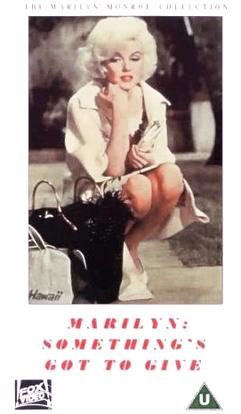

Nine hours of largely unseen footage from the film remained in the vaults at 20th Century Fox until 1999, when it was digitally restored by Prometheus Entertainment and assembled into a 37-minute segment for the two-hour documentary, Marilyn: The Final Days. It first aired on American Movie Classics on June 1, 2001, which would have been Monroe's 75th birthday. It is available on DVD.


The Tom Hanks film Cast Away has a plot similarity: the lead character is marooned on an island for several years; on his return he finds that his girlfriend has given him up for dead and has married someone else.


Friday, August 07, 2009

3:10 to Yuma has Successful 2007 Remake


3:10 to Yuma is a 1957 western film starring Glenn Ford and Van Heflin and directed by Delmer Daves. The title song, "The 3:10 to Yuma", was sung by Frankie Laine. The film was based on the short story by Elmore Leonard. The film was well received on release and is still highly regarded today.

When first released in the summer of 1957, the film became popular among audiences and critics alike for its suspenseful nature and sharp black-and-white cinematography. Ford received particular notice for his against-type villainous performance. The following year, 3:10 to Yuma was nominated for the British Academy of Film and Television Arts award for Best Film.

Since its release, the film has become a staple of cable television and has gained an audience of several generations. A critically successful remake was released in 2007.

3:10 to Yuma , the 2007 remake is directed by James Mangold and produced by Cathy Konrad, director and producer of Walk the Line, and stars Russell Crowe and Christian Bale. Filming took place in various locations in New Mexico. 3:10 to Yuma opened September 7, 2007, in the United States.

The film received two Academy Award nominations for the 80th Academy Awards. Marco Beltrami was nominated for Best Original Score, and Paul Massey, David Giammarco, and Jim Steube were nominated for Best Sound Mixing.


Thursday, July 30, 2009

Out of the Past | Its Neo-Noir Remakes


Out of the Past (originally released in Britain as Build My Gallows High) (1947) is a film noir directed by Jacques Tourneur. The movie was adapted by Daniel Mainwaring (using the pseudonym Geoffrey Homes) from his novel Build My Gallows High (also written as Homes). Uncredited revisions were made by Frank Fenton and James M. Cain. The film features Robert Mitchum, Jane Greer, Kirk Douglas, and Rhonda Fleming in which a small-town gas-station owner's mysterious past catches up with him.

In 1991, Out of the Past was added to the United States National Film Registry as being deemed "culturally, historically, or aesthetically significant."

The film is considered by film historians to be a superb example of film noir, due to its convoluted, dreamlike storyline and its chiaroscuro cinematography (cinematographer Nicholas Musuraca also shot Tourneur's Cat People).

Out of the Past was remade unofficially as CittĂ  violenta (1970) with Charles Bronson and officially as Against All Odds (1984) with Jeff Bridges, and Jane Greer as the mother of her original character in Out of the Past. -Wikipedia

Sunday, March 15, 2009

Night And Day | Cole Porters song defines his life.

"Night and Day" is a popular song by Cole Porter. It was written for the 1932 musical play Gay Divorce, and is perhaps Porter's most popular contribution to the Great American Songbook.

Fred Astaire introduced "Night and Day" on stage, and his recording of the song was a #1 hit. He performed it again in the 1934 film version of the show, renamed The Gay Divorcee, and it became one of his signature pieces. The song itself became an American standard and has been recorded by dozens of artists.

Porter was known to claim that the Islamic call to worship he heard on a trip to Morocco inspired the song.

The song was so associated with Porter that when Hollywood first filmed his life story in 1946, the movie was entitled Night and Day.

Night and Day, is a 1946 Technicolor Warner Brothers biographical film of the life of American composer and songwriter Cole Porter. It was directed by Michael Curtiz and produced by Arthur Schwartz, with Jack L. Warner as executive producer. The screenplay was by Charles Hoffman, Leo Townsend and William Bowers.

The music score by Ray Heindorf and Max Steiner was nominated for an Academy Award. The film features several of the best-known Porter songs, including the title song, "Night and Day", "Begin the Beguine" and "My Heart Belongs to Daddy".

The film stars Cary Grant as Cole Porter and Alexis Smith as his wife of 35 years, Linda Lee Porter Monty Woolley and Mary Martin appear as themselves and the rest of the cast includes Jane Wyman, Eve Arden, Alan Hale, Dorothy Malone, Donald Woods, and Ginny Simms.

The film is a highly fictionalized and sanitized version of Cole Porter's life, leaving out amongst other things references to his homosexuality. A later film biography of Porter, the 2004 De-Lovely with Kevin Kline, dealt more frankly with his sexuality.


Sunday, March 08, 2009

The Women | Contemporary Repackaging


The Women, the original play, is a comedy of manners by Clare Boothe Luce. It is an acidic commentary on the pampered lives and power struggles of various wealthy Manhattan socialites and up-and-comers and the gossip that propels and damages their relationships. While men frequently are the subject of their lively discussions and play an important role in the action on-stage, they are strictly characters mentioned but never seen.

The 1939 film version was directed by George Cukor and starred Norma Shearer and Joan Crawford. Supporting cast included Rosalind Russell, Paulette Goddard, Joan Fontaine and Mary Boland.

In 1956, the story was made into a musical film titled The Opposite Sex, starring June Allyson and Joan Collins.

Diane English directed and co-wrote a long-in-development contemporary remake of the film, starring Jada Pinkett Smith, Meg Ryan, Eva Mendes, and Annette Bening, which was released in 2008.

Monday, March 02, 2009

The Front Page, His Girl Friday & Switching Channels


The Front Page began as the hit Broadway comedy, written by one-time Chicago reporters Ben Hecht and Charles MacArthur and first produced in 1928. The authors' expert plotting and rapid-fire, streetwise dialogue delighted audiences and made their play an instant classic. Hecht and MacArthur strongly influenced many other American comic writers, especially in Hollywood. The Front Page has been adapted to film a number of times:
  • The Front Page (1931), starring Adolphe Menjou and Pat O'Brien.

  • His Girl Friday (1940), directed by Howard Hawks considered the best of the adaptations, starring Cary Grant and Rosalind Russell. The "twist" to His Girl Friday is that the one of the lead roles was converted from a man to a woman. It was originally supposed to be a straightforward retelling of The Front Page, with both the editor and reporter being men, however during auditions, Howard Hawks' secretary read reporter Hildy Johnson's lines. Hawks liked the way the dialogue sounded coming from a woman, so the script was rewritten to make Hildy female, and the ex-wife of editor Walter Burns. Most of the original dialogue and all of the characters' names (with the exception of Bruce Baldwin, Hildy's fiance, who was of course a woman in the play) were left the same.

  • Today the film is in the public domain. Download from Internet Archives...

  • The Front Page (1974), directed by Billy Wilder, starring Jack Lemmon and Walter Matthau.

  • Switching Channels (1988), starring Burt Reynolds and Kathleen Turner, with the newspaper reporters updated to television reporters and none of the original dialogue retained.
  • Night Must Fall | Adapted & Remade

    Night Must Fall is a 1937 film adaptation of the Emlyn Williams play of the same name. It was directed by Richard Thorpe and adapted by John Van Druten. It stars Robert Montgomery, Rosalind Russell, and Dame May Whitty. Whitty reprised her role from when the play was performed in London and in New York City. A handsome young Irishman charms his way into the household of a wealthy invalid, but her niece is suspicious of his motives.

    Montgomery was nominated for the Academy Award for Best Actor and Whitty for Best Supporting Actress.

    It was remade in 1964 with the same title. It was directed by Karel Reisz from a script by Clive Exton and starred Albert Finney, Mona Washbourne, and Susan Hampshire, but was not as successful as the original film.

    Night Must Fall the play was adapted into a radio play in March 1948 on the long-running radio drama series Suspense, with Robert Montgomery and Dame May Whitty reprising their original roles.

    Listen to radio play...

    A Broadway revival in the 1990s starring Matthew Broderick, essaying an Irish accent (as did Montgomery), rather than a Welsh one, performed respectably at the box office.

    Thursday, February 19, 2009

    What the Tweeple say: Pygmalian vs. My Fair Lady! Audrey Hepburn vs. Penelope Cruz?

    Pygmalion (1913) is a play by George Bernard Shaw based on the Greek myth of the same name. It tells the story of Henry Higgins, a professor of phonetics (based on phonetician Henry Sweet), who makes a bet with his friend Colonel Pickering that he can successfully pass off a Cockney flower girl, Eliza Doolittle, as a refined society lady by teaching her how to speak with an upper class accent and training her in etiquette. In the process, Higgins and Doolittle grow close, but she ultimately rejects his domineering ways and declares she will marry Freddy Eynsford-Hill – a young, poor, gentleman. This play is based on Pygmalion, a sculptor from Greek Mythology. The play led to a several adaptations including two Award Winning films:

    Pygmalion premiered on TCM tonight with My Fair Lady following. TCM viewing tweeple had some definite opinions on both.


    Worth Retweeting

    TCManiacs: RT @viste_m: New blog post: Audrey Hepburn vs Penélope Cruz http://tinyurl.com/cqyfk2

    What the Tweeple say: Pygmalian vs. My Fair Lady! Audrey Hepburn vs. Penelope Cruz?

    The Children's Hour | Code changes love triangle

    The Children's Hour, a 1934 stage play by Lillian Hellman was made into a film directed by William Wyler. However, because of the Production Code, the story was adapted into a heterosexual love triangle, the controversial name of the play was changed and the movie eventually released as These Three. Hellman reportedly worked on the screenplay, virtually all of the play's original dialogue was kept, and she was satisfied with the result, saying the play's central theme of gossip was unaffected by the changes. In 1961 the play was adapted, with its lesbian theme intact, for the film The Children's Hour, also directed by Wyler. This version starred Audrey Hepburn, Shirley MacLaine, and James Garner,


    In the play, Martha Dobie shoots herself instead of hanging herself, but the film is otherwise a quite faithful adaptation, retaining much of the same dialogue found in the play and in the 1936 film version These Three.

    In an interview for the documentary The Celluloid Closet (1996), MacLaine said she and Hepburn never talked about their characters' alleged homosexuality. She also claimed Wyler cut some scenes hinting at her character's love for Hepburn because of concerns about press reaction to the film.

    Wednesday, February 18, 2009

    Madame X | A Story Retold

    1966 and 1929 posters
    Madame X story is about a woman thrown out of her home by her jealous husband who sinks into depravity. Twenty years later, she finds herself accused of murder for saving her son, who does not know who she is. He finds himself defending her without knowing her background.

    The play originally opened in Paris, France, on 15 December 1908. An English translation of the play by John Raphael opened in New York City, New York, USA on 2 January 1910 and had 125 performances IMDb

    By 1929 it had already come to emblematize the maternal melodrama, in which devoted mothers sacrifice money and respectability so that their children can live their lives free of the taints of poverty or scandal. This "fallen woman" formula would become a genre of its own in the 1930s. The Sin of Madelon Claudet (1931), Blonde Venus (1932), Stella Dallas (1937) and Kitty Foyle (1940) all owe a dramatic debt to Bisson's original play and Barrymore's 1929 adaptation. Incidentally, Dickie Moore, who plays the object of maternal affection in Blonde Venus can be glimpsed in the puppet show sequence of Madame X. TCM

    Madame X story has since been adapted to the screen many times and the infamous Jacqueline Floriot portrayed by many actresses:

    Related Posts with Thumbnails

    Who is the mysterious TCManiac?

    First, I'll tell you who I am not. I am not affiliated with TCM. I am not some superbot created by software developers. I am not being paid by TCM or anyone else to dedicate my time to tweeting. I am a real flesh and blood human being. I am a real maniac for TCM. I really do keep my TV tuned to TCM 24-7. I created the TCManiacs twitter as a result of my sincere passion for watching Turner Classic Movies.

    How I got started?
    Well, I've been a fan of TCM since its inception. As I lay flat on my back recovering from a disabling health crisis unable to do little more than watch TV and surf the internet, I found refuge watching TCM round the clock. I soon developed an obsessive habit of keeping a browser tab open for the TCM schedule and beating Robert Osbourne's introductions to finding out facts for upcoming movies. My entire day and night became defined by the TCM line-up. At the beginning of 2009 I decided to check out twitter and lucked up on some fellow TCM fans to friend. During the 31 days Oscar I decided to dedicate a twitter just to share my TCM obsession by tweeting about every movie every day of February. I was totally overwhelmed by the number of fellow TCM maniacs that became my following. Its been a WIN WIN in everyway for me. I have had the opportunity to share fun stuff with some incredible fellow classic movie lovers and bloggers. With so many followers I became committed to maintaining the twitter schedule and finding fun stuff for upcoming TCM movies.
    How may followers show appreciation?
    As I mentioned before, I am not employed by anyone nor being paid for my time maintaining tweets and blog. However, you may express your appreciation for my labor of love by dropping a token of your appreciation in the hat. Simply click the Donate button below. Any amount your heart moves you to give no matter how small will be graciously accepted.
    What you mean to me?
    Even if you decide to skip tipping the hat, please take the time to comment or send a message with your thoughts and suggestions. Send ideas on more fun stuff you would like featured. Send me links to your own classic movie websites. I just want to hear from you! Let me know what sharing my little obsession is worth to you. Every follower is priceless to me!

    Total Pageviews

    Web Graphic Design by designables.net. Header background image compliments of MERiCG.DEViNART.com
     
    View blog top tags