Showing posts with label novels. Show all posts

Thursday, July 29, 2010

The Kennel Murder Case | Free Online Movie

The Kennel Murder Case is a 1933 murder mystery novel written by S. S. Van Dine with fictional detective Philo Vance investigating a complex locked room mystery.
A Warner Bros. film version of The Kennel Murder Case appeared in 1933. The film was directed by Michael Curtiz and starred William Powell as Philo Vance, reprising the role after appearing as Vance in three films for Paramount, and Mary Astor as Hilda Lake, the victims' niece. Many film historians (including William K. Everson, who pronounced it a "masterpiece" in the August 1984 issue of Films in Review) consider it one of the greatest screen adaptations of a Golden Age mystery novel, and rank it with the 1946 film Green for Danger.

The Kennel Murder Case was remade by Warner in 1940 as Calling Philo Vance with James Stephenson as Vance and William Clemens directing. World War II-era espionage stood in for the skulduggery of the art world in the remake.

The novel The Kennel Murder Case can be read here, courtesy of Project Gutenberg. Enjoy the film The Kennel Murder Case here or download for free at the Internet Archive.

Enhanced by Zemanta

Thursday, November 19, 2009

The Postman Always Rings Twice | Title's Meaning

The Postman Always Rings Twice is a 1946 drama-film noir based on the 1934 The Postman Always Rings Twice novel by James M. Cain. This adaptation of the novel is the best known, featuring Lana Turner and John Garfield.

The title is something of a non sequitur in that nowhere in the novel does a postman character appear, nor is one even alluded to. As such, its meaning has often been the subject of speculation by writers such as William Marling, who suggested that Cain may have taken the title from the sensational 1927 case of Ruth Snyder. Snyder was a woman who, like Cora in The Postman Always Rings Twice, had conspired with her lover to murder her husband. In that case, Snyder said she'd prevented her husband from discovering the changes she'd made to his life insurance policy by telling the postman to deliver the policy's payment notices only to her, and instructing him to ring the doorbell twice as a signal indicating he had such a delivery for her.

In fact, however, Cain gave a specific explanation of the title's origin in the preface to his subsequent novel Double Indemnity. There, he wrote that the genesis of the title for The Postman Always Rings Twice came from a discussion he'd had with screenwriter Vincent Lawrence. According to Cain, Lawrence spoke of the anxiety he felt when waiting for the postman to bring him news on a submitted manuscript. According to Cain, Lawrence noted that he would know when the postman had finally arrived because the postman always rang twice, and Cain then lit upon that phrase as a title for his novel. Upon discussing it further, the two men agreed such a phrase was metaphorically suited to Frank's situation at the end of the novel.

With the "postman" being God, or Fate, the "delivery" meant for Frank was his own death as just retribution for murdering Nick. Frank had missed the first "ring" when he initially got away with that killing. However, the postman rang again, and this time the ring was heard, when Frank was wrongly convicted of having murdered Cora, and then sentenced to die for the crime. The theme of an inescapable fate is further underscored in the novel by The Greek's escape from death in the lovers' first murder attempt, only to be done in by their second one.

In his biography of Cain, author Roy Hoopes also recounted the conversation between Cain and Lawrence that gave birth the novel's title. Hoopes's account of their conversation is similar to Cain's, but offered extended detail regarding Lawrence's comments. Specifically, in Hoopes's telling, Lawrence did not say simply that the postman always rang twice, but rather said that at times he was so anxious awaiting the postman's delivery that he'd intentionally go into his backyard trying to avoid hearing the postman's ring. However, Lawrence continued, this tactic inevitably failed because even if the postman's first ring was not noticed, he would always ring twice, and that second ring would inevitably be heard.

In the 1946 film adaptation of the novel, Frank explicitly explains the title in the terms offered by Hoopes's biography of Cain.

Friday, July 31, 2009

Three Came Home | Watch Online

Three Came Home (1950) is a wartime film made by Twentieth Century-Fox, based on the memoirs of the same name by writer Agnes Newton Keith. It depicts Keith's life in North Borneo in the period immediately before the Japanese invasion in 1942, and her subsequent internment and suffering, separated from her husband Harry, and with a young son to care for. Keith was initially interned at Berhala Island near Sandakan, but spent most of her captivity at Batu Lintang camp at Kuching, Sarawak.

Adapted and produced by Nunnally Johnson, directed by Jean Negulesco, the film starred Claudette Colbert in the lead role. The New York Times reviewer said, "It will shock you, disturb you, tear your heart out. But it will fill you fully with a great respect for a heroic soul."

The film is now in the public domain and so is available to watch in its entirety online at no charge

Monday, July 27, 2009

King Solomon's Mines | Original Movie

King Solomon's Mines is a 1937 movie, the first film adaptation of the 1885 novel by the same name by Henry Rider Haggard. It starred Paul Robeson, Cedric Hardwicke, Anna Lee, John Loder, and Roland Young. The film was produced by Gaumont British Picture Corporation, adapted by Charles Bennett (uncredited), Michael Hogan, Roland Pertwee A.R. Rawlinson (uncredited) and Ralph Spence (uncredited). It was directed by Robert Stevenson.

The 1937 film follows the original novel faithfully, except for some musical interludes deliberately added to give Paul Robeson a chance to sing. The more famous 1950 Technicolor version severely alters the tale to make Allan Quatermain into a romantic hero who falls in love with the heroine, whereas in the original film Cedric Hardwicke played him as a professorial type completely uninterested in romance. -Wikipedia

Free download of 1937 version at the Internet Archive

Tuesday, July 07, 2009

The French Lieutenant's Woman | Mise en abyme - story within a story

  1. The French Lieutenant's Woman is a 1981 film staring Meryl Streep and Jeremy Irons. It was directed by Karel Reisz and adapted by playwright Harold Pinter. It is based on the novel of the same title by John Fowles.

The plot concerns the love affair between a Victorian gentleman and a woman who has been jilted by a French officer, scandalizing the "polite society" of Lyme Regis.

In the original book, the author is very much present - constantly addressing the reader directly and commenting on his characters, and on Victorian society in general, from his Twentieth-century perspective. A direct adaptation would have required a continual voice over.

Instead, the film creates the effect of the 19th Century society looked at from a 20th Century perspective by using the literary device or conceit, story within a story, in which one story is told during the action of another story. Mise en abyme is the French term for a similar literary device.

The 19th Century Victorian story is a film being shot in the present and the actors portraying the two Victorian characters having a love affair in their actual life, with the film shifting constantly between the two centuries. And though the actors are not bound by Victorian mores in their actual present-day lives, their affair still presents hard dilemmas since each is in a relationship to somebody else.

Also, instead of trying to create a literal translation of the novel's alternate endings, Pinter's screenplay adopted a more cinematic approach by having the characters' story ends one way, the actors' another.

Thursday, April 02, 2009

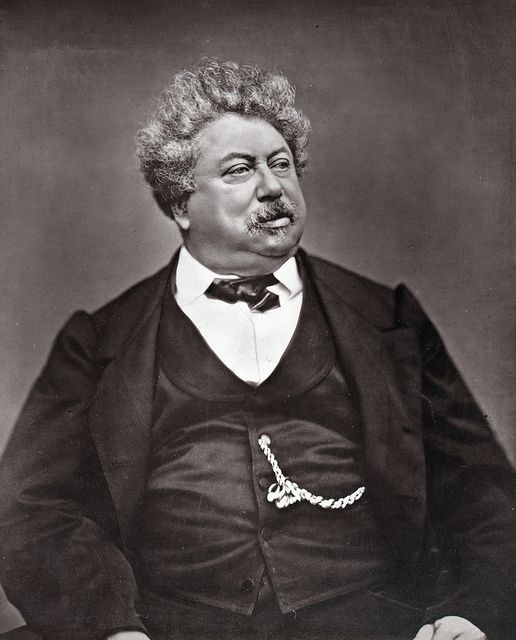
Alexandre Dumas | Inspiration for more than 200 Films has Mulatto Aristocratic Ancestry

TCM marathon of movies inspired me to Wikipedia the author behind so many of my beloved films. Classic and contemporary versions. I never tire of seeing his stories in yet another movie or TV adaption. I can usually feed off the costumes even if a bad screenplay starves me.


France has produced many great writers, none has been as widely read as Alexandre Dumas. His stories have been translated into almost a hundred languages, and have inspired more than 200 motion pictures.
He even warrants an IMDb page. Take look at the extensive list of films dated back to 1898 on
Alexandre Dumas père at the Internet Movie Database

(24 July 1802 – 5 December 1870) was a French writer, best known for his numerous historical novels of high adventure which have made him one of the most widely read French authors in the world. Many of his novels, including The Count of Monte Cristo, The Three Musketeers, Twenty Years After, and The Vicomte de Bragelonne were serialized. He also wrote plays and magazine articles and was a prolific correspondent.
I'll share some facts beyond what I was taught in high school lit class. Some I was ignorant of until now.
Dumas' paternal grandparents were Marquis Alexandre-Antoine Davy de la Pailleterie, a French nobleman, and Général commissaire in the Artillery in the colony of Saint Domingue, now Haiti, and Marie-Cesette Dumas, an Afro-Caribbean former slave.[2][3] Their son, Thomas-Alexandre Dumas, married Marie-Louise Élisabeth Labouret, the daughter of an innkeeper. Thomas-Alexandre was a general in Napoleon's army, who fell out of favor, rendering his family impoverished. Although Marie-Louise was unable to provide her son with much in the way of education, it did not hinder young Alexandre's love of books; and he read everything he could get his hands on.

Despite Alexandre Dumas' success and aristocratic connections, his being of mixed-race would affect him all his life. In 1843 he wrote a short novel, Georges, that addressed some of the issues of race and the effects of colonialism. He once remarked to a man who insulted him about his mixed-race background:

"My father was a mulatto, my grandfather was a Negro, and my great grandfather a monkey. You see, Sir, my family starts where yours ends."

In 2002 under orders of the French President, Jacques Chirac, his body was exhumed from the cemetery where he had been born, and in a televised ceremony his new coffin, flanked by four Republican Guards (costumed as the Musketeers - Athos, Porthos, Aramis, and D'Artagnan) was transported in a solemn procession to the Panthéon of Paris, the great mausoleum where French luminaries are interred. In his speech President Chirac said:

"With you, we were D'Artagnan, Monte Cristo, or Balsamo, riding along the roads of France, touring battlefields, visiting palaces and castles — with you, we dream."

In that speech President Chirac acknowledged the racism that had existed, saying that a wrong had now been righted, with Alexandre Dumas enshrined alongside fellow authors Victor Hugo and Emile Zola.

Saturday, March 28, 2009

The Adventures of Huckleberry Finn film adaptations

Adventures of Huckleberry Finn the classic novel written by Mark Twain and published in 1884 is commonly regarded one of the Great American Novels, and is one of the first major American novels written in the vernacular, characterized by local color regionalism. The Adventures of Huckleberry Finn, is its 1939 film adaptation, starring Mickey Rooney in the title role.

Huckleberry Finn is the 1974 musical film version of Mark Twain's American classic boyhood adventure story, The Adventures of Huckleberry Finn.

The movie was produced by Reader's Digest and Arthur P. Jacobs (well-known for his role in the production of the Planet of the Apes films) and starred Jeff East as Huckleberry Finn and Paul Winfield as Jim. The film contains original music and songs, such as Freedom and Cairo, Illinois, by the popular "Sherman Brothers," Robert B. Sherman and Richard M. Sherman.

Both versions periodically shown on TCM.


The popularity of this story has led it to revisited in film may times. Here's a full list of film adaptations:

Thursday, March 26, 2009

The Scarlet Pimpernel | View Film or Read eBook Online

The Scarlet Pimpernel is a 1934 adaptation of The Scarlet Pimpernel, the classic adventure novel by Baroness Orczy. It was produced by Alexander Korda, directed by Harold Young and stars Leslie Howard and Merle Oberon, along with Raymond Massey.

Filmed in black and white, Howard set the standard with his portrayal of Sir Percy Blakeney and this version is widely regarded as the best screen adaptation.

The Project Gutenberg eBook of The Scarlet Pimpernel, by Baroness Orczy »

Film Cast of Charactors

Alexander Korda, a Hungarian, who had been born in a town not far from the Orczy farm, had recently had great success with the actor Charles Laughton in the film The Private Life of Henry VIII, so he understandably asked the famous British actor to play the role of Sir Percy. But when the announcement went out to the press, the reaction from the Pimpernel's many fans was horror — the pug-nosed Laughton to play the suave Sir Percy? Never! Korda was nothing if not pragmatic and he offered the role to Leslie Howard, with Merle Oberon as Marguerite, although Orczy herself believed Oberon was miscast.
Watch complete film (public domain)

The Great Escape | Fact vs Fiction


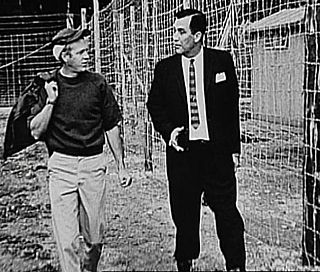
Steve McQueen with Wally Floody, a former POW who was actually part of the real Great Escape plan and acted as technical advisor on the film.


The Great Escape is a 1963 film which features an all-star cast seeking to break out of a German POW camp during World War Two. Although largely fictional, elements of the film were based on fact with events and characters condensed.

While the filmmakers made every effort to remain faithful to Paul Brickhill's account of the escape, given the scope and the length of time over which the book unfolds it was inevitable that some adjustments would have to be made to allow the story to be presented on screen. The result is that much of the action has been condensed in time and many of the men appear as composites of the real-life individuals who appear in the book.

Composite Characters Explained »

One important liberty taken by the film makers was that, in actual fact, no serving member of the American armed forces was involved in the final escape. Although not originally intended, the director John Sturges was told to write American heroes into the script or abandon the project. While fictional American characters dominated the film, it does concede that it was a mainly British led operation.

General Narrative

One important fact omitted from the film was the help the POWs received from outside the camp, some of it from their home countries; they received much material that proved invaluable for this and other escapes. Acting through secret agencies such as MI9, families from Allied nations would send maps, papers, tools as disguised material hidden in gifts, books, food, and other objects. Ex-POWs asked the film-makers to exclude such details lest it jeopardize future POW escapes.

The theft of a German airplane (in the film, a Bücker Bü 181) by Hendley and Blythe is also fictitious, although there was a failed attempt by Lorne Welch and Walter Morison to steal a plane following the delousing party escape a year earlier. Likewise the movie shows the plane going over Bavaria's Neuschwanstein Castle on the way to Switzerland; the 181 range is only about 497 miles — in real life their flight from Stalag Luft III would have gone down at least 50 miles from the Swiss border — instead of going down near the Swiss Alps.

A scene shows a choir singing to cover the noise of work done for the escape, but, in reality, it was a group of prisoners who formed a musical band and called themselves the "Sagan Serenaders". Future television meteorologist Wally Kinnan, then a First Lieutenant in the US Army Air Corps, and Pilot Officer Leonard Whiteley of the British Royal Air Force had organized the group. The Serenaders received musical instruments from aid organizations and whatever the German captors could scrounge. Musicians Tiger Ward, Nick Nagorka and pianist John Bunch were also members of this group.

Number of escapees

Only 76 of the projected 200 men escaped while an air raid occurred; only three POWs escaped Germany into neutral territory: the Norwegians Per Bergsland and Jens Müller who escaped to Sweden, and the Dutchman Bram van der Stok who reached Spain. Though Roger Bartlett in the film speaks of freeing 250 men, there is no account of a target other than 200, and in the movie itself only about 15 POWS go through the tunnel to the forest.

The tunnels

The film depicts Tom's entrance as being under a stove and Harry's as in a drain sump in a washroom. In reality, Dick's entrance was the drain sump, Harry's was under the stove, and Tom's was in a darkened corner.

British veterans mark Great Escape anniversary »

British veterans of the Second World War prison camp that featured in the film The Great Escape made an emotional return to the site of the getaway tunnel on the 65th anniversary of the breakout immortalised in the Hollywood film.

Monday, March 16, 2009

Show Boat (1936) vs Show Boat (1951)


Show Boat (1936) is a film based on the musical by Jerome Kern (music) and Oscar Hammerstein II (script and lyrics), which the team adapted from the novel by Edna Ferber.

This film version from Universal Pictures, which had in 1929 filmed a part-talkie version of Ferber's original novel, is, for the most part, a faithful adaptation of the famed Broadway musical version of the book, and retains the interracial subplot so important to both the novel and the show.

This film version of Show Boat stars Irene Dunne and Allan Jones, with Charles Winninger, Paul Robeson, Helen Morgan, Helen Westley, Queenie Smith, Sammy White, Donald Cook, Arthur Hohl, and Hattie McDaniel. It was directed by Frankenstein / Bride of Frankenstein director James Whale, who tried to bring as many people from the stage production as he could to work on the film.

Robeson, for whom the role of Joe was actually written, had appeared in the show onstage in London in 1928 and in the Broadway revival of 1932. Dunne had been brought in to replace Norma Terris, the original Magnolia, in the touring version of the show, and had toured the U.S. in the role beginning in 1929.

According to film historian Miles Kreuger in his book Show Boat: The History of a Classic American Musical, great care was taken by director James Whale to insure a feeling of complete authenticity in the set and costume design for the 1936 film.

The 1936 version of Show Boat is considered by nearly all film critics to be one of the classic film musicals of all time, and one of the best stage-to-film adaptations ever made.

Except for the final sequence and the three additional songs written especially for the film by Kern and Hammerstein, it follows the stage musical extremely closely, unlike the 1929 film and the 1951 version released by MGM. It also retains much of the comedy in the show.

The 1936 Show Boat was successful at the box office, but was withdrawn from circulation in the 1940's, after MGM bought the rights so that they could film a Technicolor remake; however, MGM's version did not begin filming until 1950, and was released in the summer of 1951. The controversy surrounding Paul Robeson's supposed Communist leanings further assured that the 1936 film would not be seen for a long time, and it was not widely seen again until after Robeson's death in 1976.

The Kern-Hammerstein musical was remade in 1951 by MGM in Technicolor, starring Kathryn Grayson, Ava Gardner, and Howard Keel, with Joe E. Brown, Marge Champion, Gower Champion, William Warfield, Robert Sterling, Agnes Moorehead and Leif Erickson. The film was the first screen version of Show Boat not to include any of the actors who had appeared in the original 1927 stage production (if one does not count Till the Clouds Roll By as a film version of Show Boat).

It was adapted by John Lee Mahin and was directed by George Sidney. Filmed in the typical MGM lavish style, this version is the most financially successful of the film adaptations of the play, and is one of MGM's most popular musicals, though arguably one of the studio's less inventive ones. It was the first film version of "Show Boat" not to feature Robert Russell Bennett's stage orchestrations in one form or another.

Oscar Hammerstein II's dialogue was almost completely rewritten (by Mahin), the story was given a major overhaul near the end of the film and the changes are considered to make this version of the story quite distinct from other versions. Changes included keeping the characters of Magnolia and Gaylord significantly younger at the end than in the play, and the expansion of the role of Julie to give her character greater depth. Kim (Magnolia and Ravenal's daughter) appears only as a baby and a little girl in this version. Nearly all of the purely comic scenes were removed, as much of the comedy in the show has no direct bearing on the plot.

The version of "Ol' Man River" heard here is considered by film historians to be by far the best moment, both musically and pictorially, in the film. Musical theatre historian Miles Kreuger, who had many harsh words for the 1951 Show Boat in his 1977 book Show Boat: The History of a Classic American Musical nevertheless had nothing but high praise for this sequence. It was staged and directed by an uncredited Roger Edens during an illness of George Sidney, who directed the rest of the film. However, the "Ol' Man River" sequence in the 1936 film version of the show, with its tracking pan around the seated, singing figure of Paul Robeson, and its expressionistic montages of field and dock workers performing their tasks, is perhaps even more highly regarded.

The aspects of the original stage version dealing with racial inequality, especially the story line concerning miscegenation, were highly "sanitized" and deemphasized in the 1951 film MORE »

Show Boat the musical is widely considered one of the most influential works of the American musical theatre. As the first true American "musical play."

Sunday, March 15, 2009

The Story of G.I. Joe | Figurine of "Ernie Pyle" War Correspondent seated at his typewriter

The Story of G.I. Joe (1945) is a war film directed by William Wellman, starring Burgess Meredith and Robert Mitchum. The film was nominated for four Academy Awards, including Mitchum's only nomination for Best Supporting Actor.

The story is a tribute to the American infantryman ("G.I. Joe") during World War II, told through the eyes of Pulitzer Prize-winning war correspondent Ernie Pyle, with dialogue and narration lifted from Pyle's columns. The film concentrates on one company, ("C Company, 18th Infantry"), that Pyle accompanies into combat in Tunisia and Italy. The friendships that grow out of his coverage lead Pyle to relate the misery and sacrifice inherent in their plight and their heroic endurance of it. Although the company has the designation of an actual unit, that unit did not participate in the combat in Italy that makes up the preponderance of the film, and actually represents the units of the 34th and 36th Infantry Divisions that Pyle did cover in Italy, and thereby all American G.I.s.

Although filmed with the cooperation of Pyle, the film premiered two months to the day after he was killed in action on Ie Shima during the invasion of Okinawa. In his February 14, 1945, column "In the Movies", Pyle commented: "They are still calling it "The Story of G.I. Joe." I never did like the title, but nobody could think of a better one, and I was too lazy to try."


I discovered this terrific figurine of "Ernie Pyle" War Correspondent seated at his typewriter who wrote the classic "The Story of G.I. Joe"
The "companion piece" to DD076 is our seated at his typewriter "Ernie Pyle" War Correspondent. This terrific little figure is full of character another "tribute" to the war correspondent Ernie Pyle who wrote the classic "The Story of G.I. Joe" which was later made into a great WW2 movie starring Robert Mitchum and Burgess Meredith as Pyle himself. Sadly, Ernie was killed later in the war. MORE»

Friday, March 13, 2009

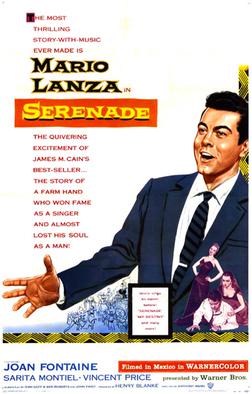
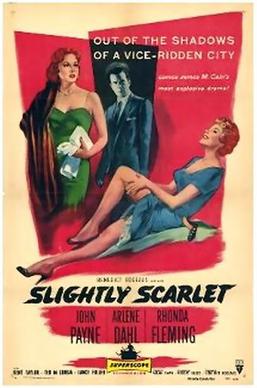
Classic crime films adapted from James M. Cain novels

James Mallahan Cain (July 1, 1892October 27, 1977) was an American journalist and novelist. Although Cain himself vehemently opposed labelling, he is usually associated with the hardboiled school of American crime fiction and seen as one of the creators of the roman noir.
"I make no conscious effort to be tough, or hard-boiled, or grim, or any of the things I am usually called. I merely try to write as the character would write, and I never forget that the average man, from the fields, the streets, the bars, the offices and even the gutters of his country, has acquired a vividness of speech that goes beyond anything I could invent, and that if I stick to this heritage, this logos of the American countryside, I shall attain a maximum of effectiveness with very little effort."
(from the Preface to Double Indemnity)

Selected films adapted from Cain's novels.


Sunday, March 08, 2009

The "Kitty Foyle" Dress


Kitty Foyle, subtitled The Natural History of a Woman, is a 1940 film starring Ginger Rogers. The film was adapted from the eponymous 1939 novel by Christopher Morley. Ginger is not dancing and Ginger is not adorned in glamorous ballroom dresses. She's a working girl! In fact, Rogers' dress became a popular style, taking the name of the film.

A Kitty Foyle is a dress style of the 1940s characterized by a dark fabric and contrasting (usually white) collar and cuffs. This dress has also been worn by characters such as Lenore, the Cute Little Dead Girl and Wednesday Addams.

Reminds me of impact of "Annie Hall" on 70s fashions. More about Kitty Foyle dress from the blogosphere:

If Wednesday Adams Digs the Kitty Foyle, Then So Do I

The Kitty Foyle crops up everywhere…notably on Christina Ricci as Wednesday Adams (god i loved those movies). Over the years, it’s taken the shape of a bow at the neckline (rather than/as well as a contrasting collar) and a bright coloured dress contrasted with white or another colour. But the classic b-n-w version always ends up resurfacing.

I don’t have a KF myself, but you’ve gotta love them. Clean and classy. Plus it gives you full licence to maximise the size of your coiffe, a la Ginger Rogers. MORE »

In 1940, Hollywood offered audiences the quintessential White Collar Girl: Ginger Rogers as Kitty Foyle:

The collar for example, was a sign, expressively nuanced by size, line, decorative quality, and shape; Kitty's small, neat, crisply starched, simple white collar expressed the ideal character of the working girl. Better yet, it effected metaphorical literalization through design. Life explained, "she wears the white collar which gave her kind its name." MORE »

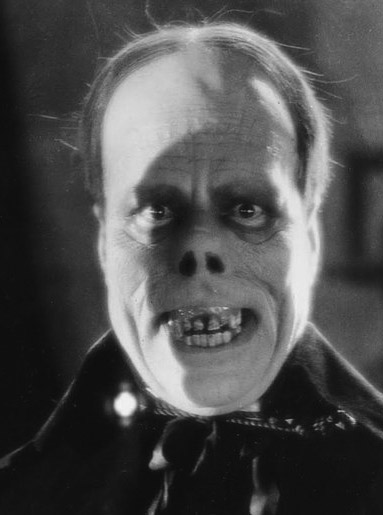
Lon Chaney's The Phantom of the Opera | Novel & DVD Download


The Phantom of the Opera is a 1925 silent film directed by Rupert Julian adaptation of the Gaston Leroux novel of the same title. The film featured Lon Chaney in the title role as the masked and facially deformed Phantom who haunts the Paris Opera House, causing murder and mayhem in an attempt to force the management to make the woman he loves a star. It is most famous for Lon Chaney's intentionally horrific, self-applied make-up, which was kept a studio secret until the film's premiere.

Following the success of The Hunchback of Notre Dame in 1923, Lon Chaney was once again given the freedom to create his own make-up as the Phantom, a habit which became almost as famous as the films he starred in. Chaney pulled his eyeballs out from their sockets with thin wires, so that his eyes appeared to bulge out and their sockets became very deep. He then kept his eyes in their bulged-out position with wires and painted his eye sockets black, giving a skull-like impression to them. He also pulled the tip of his nose up and pinned that in place with wire, enlarging his nostrils with black paint, and putting a set of jagged false teeth into his mouth to complete the ghastly deformed look of the Phantom. Although nowhere near as elaborate as his make-up for Quasimodo in The Hunchback of Notre Dame, it was no less painful, and no less effective either. When audiences first saw The Phantom of the Opera, they were said to have screamed or fainted at the scene where Christine pulls the concealing mask away, revealing his skull-like features to the audience (but not, for a few seconds, to Christine).

Chaney's appearance as the Phantom in the film has been the most accurate depiction of the title character, based on the description given in the novel, where Erik the Phantom is described as having a skull-like face with a few wisps of black hair on top of his head. As in the novel, Chaney's Phantom has a full facial deformity present since birth, as opposed to the partial facial disfigurement caused by acid or fire (depending on the adaptation) seen in later adaptations of The Phantom of the Opera.

It is in the appearance of the Phantom that Lon Chaney is most associated with in the mind of the public.

Switchblade Symphony - Phantom Of The Opera - Movie Download »

Thursday, March 05, 2009

Nancy Drew Mystery Stories Warner Bros. Films | DVDs & Games

Nancy Drew is an eighteen year-old girl and a fictional character, the heroine of the popular Nancy Drew Mystery Stories series aimed at the children-young adult audience, and written under the collective pseudonym "Carolyn Keene".

Former child actress Bonita Granville portrayed Nancy Drew in four Warner Bros. films directed by William Clemens in the late 1930s: Nancy Drew: Detective (loosely based on The Password to Larkspur Lane), Nancy Drew: Reporter, Nancy Drew: Trouble Shooter, and Nancy Drew and the Hidden Staircase, the only one to borrow its title from a book in the series, although the plot was altered substantially. Frankie Thomas was cast as the rechristened "Ted" Nickerson, who acted more as a sidekick than boyfriend. Carson Drew remained her father, but Hannah Gruen became Effie Schneider, and George and Bess were eliminated completely. Among the notable features of the film series was Nancy, said to be 16 and played by an actress of the same age, often shown driving an automobile, which was uncommon for a female teenager in the 1930s. Another very unconventional feature of the films was that Ted was on several occasions shown disguising himself as a woman. The use of men in "drag" can be traced all the way back to Shakespeare's plays and Japanese Kabuki theater, where boys played all the female roles. However, in 1930s America, a boy wearing women's clothing was quite a shock! At any rate, the movies do not resemble the books' characters very much at all. Nancy is rather whiny and annoying, Ned/Ted can't seem to get a backbone and say "No!" when Nancy cajoles him into one crazy scheme after another, and Effie/Hannah is depicted as a scatterbrained ninny. The films were compiled into a special DVD release by Warner Bros. in 2007.

Over the years Nancy Drew has been adapted and franchised for additional series publications, television, products and even computer games.

YES! I found the DVD.

The Original Nancy Drew Movie Mystery Collection (Detective / Reporter / Troubleshooter / Hidden Staircase) (1939) »

More information on Nancy Drew Games »

Check out this blog for gaming tips
Nancy Drew Games Your guide to the world of Nancy Drew »

Related Posts with Thumbnails

Who is the mysterious TCManiac?

First, I'll tell you who I am not. I am not affiliated with TCM. I am not some superbot created by software developers. I am not being paid by TCM or anyone else to dedicate my time to tweeting. I am a real flesh and blood human being. I am a real maniac for TCM. I really do keep my TV tuned to TCM 24-7. I created the TCManiacs twitter as a result of my sincere passion for watching Turner Classic Movies.

How I got started?
Well, I've been a fan of TCM since its inception. As I lay flat on my back recovering from a disabling health crisis unable to do little more than watch TV and surf the internet, I found refuge watching TCM round the clock. I soon developed an obsessive habit of keeping a browser tab open for the TCM schedule and beating Robert Osbourne's introductions to finding out facts for upcoming movies. My entire day and night became defined by the TCM line-up. At the beginning of 2009 I decided to check out twitter and lucked up on some fellow TCM fans to friend. During the 31 days Oscar I decided to dedicate a twitter just to share my TCM obsession by tweeting about every movie every day of February. I was totally overwhelmed by the number of fellow TCM maniacs that became my following. Its been a WIN WIN in everyway for me. I have had the opportunity to share fun stuff with some incredible fellow classic movie lovers and bloggers. With so many followers I became committed to maintaining the twitter schedule and finding fun stuff for upcoming TCM movies.
How may followers show appreciation?
As I mentioned before, I am not employed by anyone nor being paid for my time maintaining tweets and blog. However, you may express your appreciation for my labor of love by dropping a token of your appreciation in the hat. Simply click the Donate button below. Any amount your heart moves you to give no matter how small will be graciously accepted.
What you mean to me?
Even if you decide to skip tipping the hat, please take the time to comment or send a message with your thoughts and suggestions. Send ideas on more fun stuff you would like featured. Send me links to your own classic movie websites. I just want to hear from you! Let me know what sharing my little obsession is worth to you. Every follower is priceless to me!

Total Pageviews

Web Graphic Design by designables.net. Header background image compliments of MERiCG.DEViNART.com
 
View blog top tags