
An Independence Day Treat from TCM, The Flag: A Story Inspired By the Tradition of Betsy Ross (1927) is a rare example of 2-strip Technicolor silent short from MGM. Score added by Vivak Maddala in 2002. Directed by Arthur Maude. This is the romanticized patriotic story of George Washington (Francis X Bushman) trying to talk Betsy Ross (Enid Bennett) into creating a flag for the country. Only 20 minutes long. Unremarkable plot, but stunning to watch. The 2 color process is an aesthetically pleasing medium for Betsy's creamy white complexion against a patriotic palette of rich reds and navy blues.
Showing posts with label silent film. Show all posts
Showing posts with label silent film. Show all posts
Sunday, July 04, 2010


Sunday, March 22, 2009
German Expressionist Murnau's Sunrise | Groundbreaking cinematography wins at first Oscars


Sunrise: A Song of Two Humans (1927), also known as Sunrise, is an American film directed by German film director F. W. Murnau. The story was adapted by Carl Mayer from the short story Die Reise nach Tilsit by Hermann Sudermann.
Sunrise won an Academy Award for Unique and Artistic Production at the first ever Oscar ceremony in 1929. In 1989, this film was deemed "culturally, historically, or aesthetically significant" by the United States Library of Congress and selected for preservation in their National Film Registry. In a 2002 critics' poll for the British Film Institute, Sunrise was named the seventh-best film in the history of motion pictures.
Sunrise won an Academy Award for Unique and Artistic Production at the first ever Oscar ceremony in 1929. In 1989, this film was deemed "culturally, historically, or aesthetically significant" by the United States Library of Congress and selected for preservation in their National Film Registry. In a 2002 critics' poll for the British Film Institute, Sunrise was named the seventh-best film in the history of motion pictures.
Sunrise was made by F. W. Murnau, a German director who was one of the leading figures in German Expressionism, a style that uses distorted art design for symbolic effect. Murnau was invited by William Fox to make an Expressionist film in Hollywood.

The resulting film features enormous stylized sets that create an exaggerated, fairy-tale-like world. Murnau manages to use a subtle technique of animal and plant imagery as an important tool to indicate the mood or tone in a particular scene and accent the deconstruction of generic dichotomies.
Titles are used sparingly in the movie. Previously, in Germany, Murnau had made a film called The Last Laugh which told its story with only one title card (to explain the ending). In Sunrise, there are long sequences without titles, and the bulk of the story is told through images in a similar style. Murnau makes extensive use of forced perspective throughout the film. Of special note is a shot of the City where you see normal-sized people and sets in the foreground and little people in the background along with much smaller sets.
Titles are used sparingly in the movie. Previously, in Germany, Murnau had made a film called The Last Laugh which told its story with only one title card (to explain the ending). In Sunrise, there are long sequences without titles, and the bulk of the story is told through images in a similar style. Murnau makes extensive use of forced perspective throughout the film. Of special note is a shot of the City where you see normal-sized people and sets in the foreground and little people in the background along with much smaller sets.
The film is also notable for its groundbreaking cinematography (by Charles Rosher and Karl Struss), and features some particularly impressive tracking shots that influenced later filmmakers. These innovations have led some to call it the "Citizen Kane" of American silent cinema.
One excellent example of this cinematography is the scene in which, after the abortive murder attempt, the man and wife take the trolley into the city. In this trip the characters must make the emotional journey from fear and distrust to a renewed relationship, while making the physical journey from the country to the city.

Monday, March 09, 2009
Un Chien Andalou (1929)
Un Chien Andalou, or An Andalusian Dog a creepy and weird avant garde masterpiece written by Salvador Dali and Luis Bunuel. Created in 1929, the 17 minute film was the first directed by Luis Bunuel, and features several scenes that are legendary. Who could forget the eyeball getting sliced open with a straight razor, or the ants crawling out of the hand, or the man hauling two priests (Dali and Bunuel no less) attached to two huge grand pianos, each with a bloody dead donkey inside. Nope - one doesn't forget these images easily. MORE »
Had this bookmarked, diydanna...

Sunday, March 08, 2009
Lon Chaney's The Phantom of the Opera | Novel & DVD Download


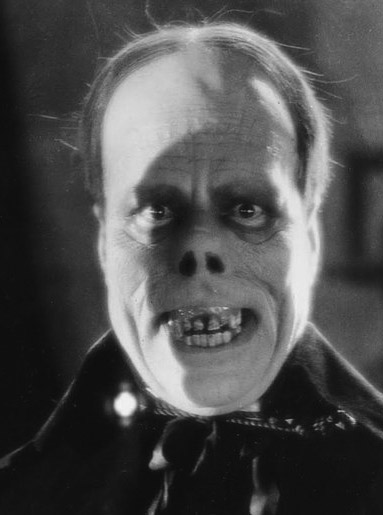
The Phantom of the Opera is a 1925 silent film directed by Rupert Julian adaptation of the Gaston Leroux novel of the same title. The film featured Lon Chaney in the title role as the masked and facially deformed Phantom who haunts the Paris Opera House, causing murder and mayhem in an attempt to force the management to make the woman he loves a star. It is most famous for Lon Chaney's intentionally horrific, self-applied make-up, which was kept a studio secret until the film's premiere.
Following the success of The Hunchback of Notre Dame in 1923, Lon Chaney was once again given the freedom to create his own make-up as the Phantom, a habit which became almost as famous as the films he starred in. Chaney pulled his eyeballs out from their sockets with thin wires, so that his eyes appeared to bulge out and their sockets became very deep. He then kept his eyes in their bulged-out position with wires and painted his eye sockets black, giving a skull-like impression to them. He also pulled the tip of his nose up and pinned that in place with wire, enlarging his nostrils with black paint, and putting a set of jagged false teeth into his mouth to complete the ghastly deformed look of the Phantom. Although nowhere near as elaborate as his make-up for Quasimodo in The Hunchback of Notre Dame, it was no less painful, and no less effective either. When audiences first saw The Phantom of the Opera, they were said to have screamed or fainted at the scene where Christine pulls the concealing mask away, revealing his skull-like features to the audience (but not, for a few seconds, to Christine).
Chaney's appearance as the Phantom in the film has been the most accurate depiction of the title character, based on the description given in the novel, where Erik the Phantom is described as having a skull-like face with a few wisps of black hair on top of his head. As in the novel, Chaney's Phantom has a full facial deformity present since birth, as opposed to the partial facial disfigurement caused by acid or fire (depending on the adaptation) seen in later adaptations of The Phantom of the Opera.
It is in the appearance of the Phantom that Lon Chaney is most associated with in the mind of the public.
Switchblade Symphony - Phantom Of The Opera - Movie Download »
Subscribe to:
Posts (Atom)


 Posts
Posts


